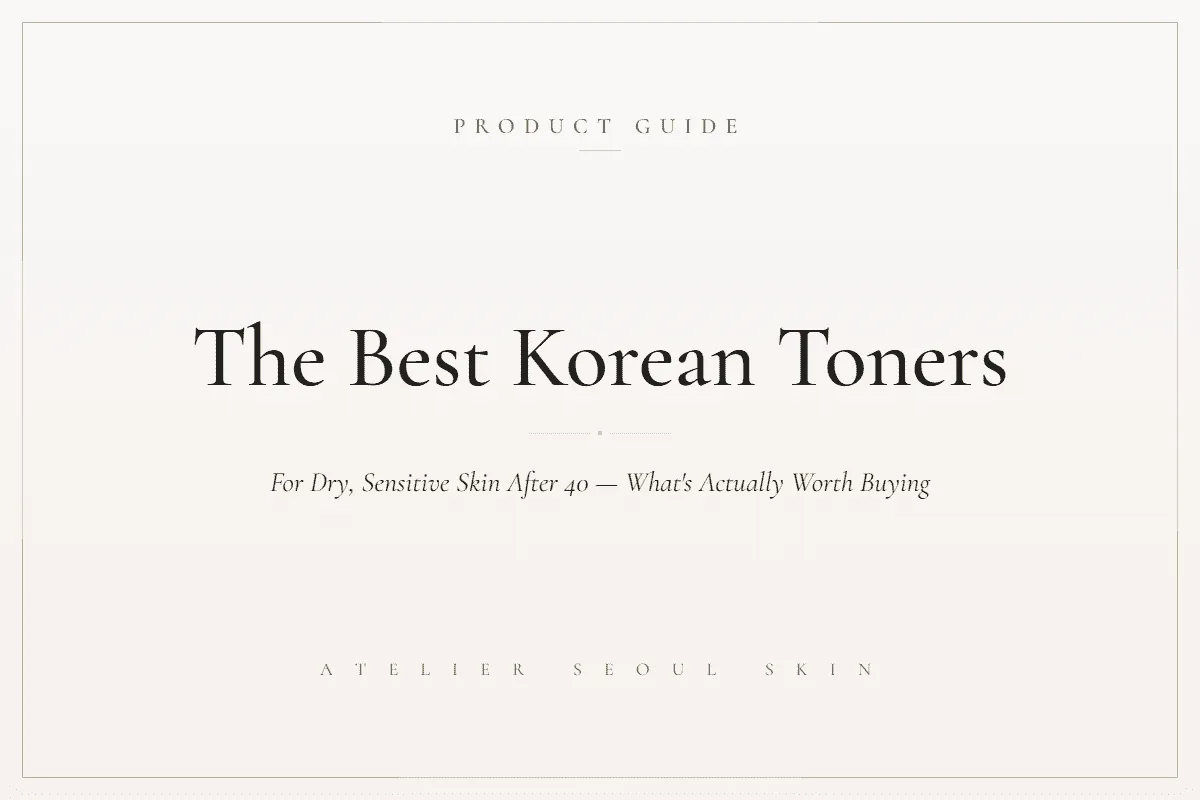
The Best Korean Toners for Dry, Sensitive Skin After 40: What’s Actually Worth Buying
This post contains affiliate links. If you buy through them, I may earn a small commission at no extra cost to you. Read my Affiliate Disclosure.
If you’ve come to Korean skincare through the 10-step-routine content on social, you probably think a “toner” is that alcohol-stinging astringent your teenage bathroom cabinet used to contain. It isn’t. A Korean hydrating toner is basically a watery first layer of hydration — often indistinguishable from what the industry calls an essence — and for dry, sensitive, mature skin it’s arguably the most under-rated step in the whole routine.
This is a round-up of the Korean hydrating toners I’ve actually used, thought about, and in some cases bought three bottles of. I’m 43, my skin is dry, sensitive, and barrier-reactive, and I’ve spent the last three years narrowing down what works. Some of what you see praised everywhere simply doesn’t suit skin over 40. The ones below do.
What a Korean Hydrating Toner Should Actually Do
If you only remember one thing from this post, remember this: for dry, sensitive, over-40 skin, a toner’s job is not to “adjust pH” or “clarify” or “prep” in any pore-tightening sense. Its job is simple:
- Deliver a burst of humectants (glycerin, hyaluronic acid, panthenol, beta-glucan) to damp skin so everything after it absorbs better.
- Calm the skin after cleansing, especially if your water is hard or your cleanser was slightly stripping.
- Support the barrier with ferments, centella, madecassoside, or low-dose niacinamide.
- Feel like nothing. No sting, no tack, no residue, no “fresh” tingle.
Any toner that contains alcohol denat high up, witch hazel as a headline ingredient, or fragrance in the top half of the list is almost certainly the wrong choice for mature, dry skin. I know it’s tempting because they feel “active.” They’re mostly just irritating skin you’re trying to protect. If your skin already feels reactive, it’s worth ruling out barrier damage before adding anything new.
How I Tested These
I’m not a lab. My “testing” looks like this: I use a toner twice a day for at least four weeks, sometimes longer, on otherwise-unchanged routines. I note whether my skin feels more or less dry over the day, whether it layers well under ceramide moisturiser, whether anything else in the routine starts to sting (a sign of subtle irritation), and whether I’d reach for the bottle again if nobody was looking.
A few of these were sent to me over the years; most I bought with my own money from Jolse, YesStyle, or my local Korean beauty store. I’ve flagged which is which wherever it matters. Some links in this post are affiliate links, so I may earn a small commission if you buy through them. This does not affect which products I recommend.
The Korean Toners Worth Buying for Dry, Sensitive, Mature Skin
1. Beauty of Joseon Glow Replenishing Rice Milk
If you want one toner to start with, start here. 70% rice extract, niacinamide, and alpha-arbutin in a slightly milky, barely-thick texture. It hydrates without tackiness, gives a genuinely softer feeling within a week, and layers under everything. The niacinamide level sits comfortably under 5%, so it’s rare to see irritation. I’ve used six bottles.
Best for: dry and dehydrated skin that’s also worrying about dullness or early pigmentation. View on Jolse (also on Stylevana)
2. Pyunkang Yul Essence Toner
Famously short ingredient list — the hero ingredient is milk vetch root extract. Watery, absolutely no scent, no shine, no sting. This is the one I reach for when my skin has been pushed too far with retinol or acids and I need a total reset. It doesn’t dazzle on first use; it earns its place over three weeks when you notice your skin just… calmer.
Best for: reactive skin, anyone in the middle of a barrier recovery week, minimalists. View on Jolse (also on Stylevana)
3. I’m From Mugwort Essence
Mugwort (artemisia) is the calming ingredient Korean brands have leaned into for redness-prone skin, and this essence is the standout. 100% mugwort extract as the first ingredient. Slightly herbal smell (not fragrance — the plant itself). I use it on flush days, after a long flight, or when perimenopausal rosacea-style redness flares. Within minutes skin looks less angry.
Best for: redness, post-active soothing, anyone whose skin flushes easily in heat. View on Jolse (also on Stylevana)
4. Cosrx The Hyaluronic Acid 3 Serum (used as a toner layer)
Technically a serum, but it’s watery enough to function as a hydrating toner, and I often use it that way as the first damp-skin layer. Sodium hyaluronate, panthenol, and a clean, fragrance-free formula. If your toner step keeps leaving skin thirsty by mid-afternoon, this one solves it. View on Jolse (also on Stylevana)
5. Haruharu Wonder Black Rice Hyaluronic Toner
A gentler, slightly thicker alternative to the Beauty of Joseon rice toner. Fermented black rice, mild BHA at a level low enough most sensitive skin tolerates it, and a lightly milky feel. The BHA isn’t enough to exfoliate aggressively; it just keeps the surface smoother over time. Avoid if you truly cannot tolerate any BHA, but most over-40 skin copes well with it here.
Best for: dry skin with occasional congestion, mature skin that wants both hydration and texture support. View on Jolse (also on Stylevana)
6. Manyo Factory Galactomyces Niacin Special Treatment Essence
A ferment-forward essence in the SK-II category at a fraction of the price. Galactomyces ferment filtrate, niacinamide, and enough hydration to layer well. The “fermented” texture is slightly viscous, which I know some people don’t love — once you pat it in, it disappears. Over a month I noticed skin looked visibly more even.
Best for: hyperpigmentation and dullness as the primary concern. I’ve compared gentle pigmentation actives in niacinamide vs azelaic acid if you’re deciding where to focus. View on Stylevana
7. Anua Heartleaf 77% Soothing Toner
Widely praised, and for redness it deserves the praise. Centella-adjacent heartleaf at 77% gives real calming benefit. Where I’d push back on the internet consensus: it’s not as hydrating as some of the others on this list, so on properly dry menopausal skin you’ll want to layer something humectant-rich after it. Think of it as the calming step, not the hydrating step.
Best for: reactive, redness-prone skin. Layer under a HA or snail mucin product. View on Jolse (also on Stylevana)
8. Missha Time Revolution The First Treatment Essence (Intensive Moist)
A classic for a reason. Fermented yeast essence that genuinely helps with skin softness and elasticity over months. The “Intensive Moist” version is noticeably better for dry and mature skin than the original. Expensive for Korean skincare, but it lasts (I get 5–6 months from a bottle using two pumps twice a day).
Best for: mature skin that wants the luxury-essence feel without the Western department-store markup. View on Jolse (also on Stylevana)
9. Round Lab 1025 Dokdo Toner
Based on deep-sea water from Dokdo Island, with panthenol and beta-glucan doing most of the hydration work. Very watery, mildly mineral-feeling, and zero fragrance. It’s my current “press layer” — I dampen my palms with it and press four or five times before my serum. It doesn’t have a single heroic ingredient, but the formula as a whole is quietly excellent for barrier skin. View on Jolse (also on Stylevana)
10. Some By Mi Snail Truecica Miracle Repair Toner
The snail + centella combo Korean brands do very well. Mildly thicker than a typical toner, very comforting after retinol nights, and it genuinely does seem to help fade post-breakout marks faster. If you want to understand why snail mucin keeps showing up on this list, I’ve written about the comparison in snail mucin vs hyaluronic acid for mature skin.
Best for: recovering skin, post-active nights, any skin doing visible repair work. View on Jolse (also on Stylevana)
Honourable Mentions
- Klairs Supple Preparation Unscented Toner. Gentle, fragrance-free, a reliable beginner toner. Slightly less exciting than the hero products above.
- Laneige Cream Skin Refiner. Lovely texture, but has fragrance — fine for some, not for the most sensitive.
- Numbuzin No. 3 Skin Softening Serum Toner. Panthenol-heavy and genuinely softening; worth trying if barrier softness is your main issue.
What I’d Actually Skip for Dry, Mature Skin
Korean or not, these categories tend to be wrong for skin over 40:
- “AHA/BHA daily exfoliating toners.” Too much daily acid for a thinning barrier. Save any acid for once or twice a week.
- Alcohol-denat-forward “astringents.” These still exist. They are not for you.
- Toners marketed for oily, acne-prone teenage skin. Different problem, different chemistry.
- Anything strongly fragranced — floral, fruity, or “fresh.” Fine for some skin, but menopausal skin is more likely to react.
- Toners in fine-mist-spray-only packaging for your main routine. Spray mists are fine as a top-up; they tend to under-deliver product as your primary hydrating step.
How to Actually Use a Korean Hydrating Toner
The instructions in Korean brands’ own marketing usually suggest a cotton pad. For dry skin, I think that’s the wrong call — you’re lifting product away instead of into the skin. Here’s what I do instead:
- Apply to damp skin. Straight after cleansing, before a single drop of water has evaporated.
- Use hands, not cotton pads. Pour a small pool into your palms, press gently over face and neck.
- Layer two or three times. This is the “7-skin method” diluted for real life. Skin feels bouncier, everything after it absorbs faster.
- Don’t wait for it to dry. Damp skin layering is the whole point.
- Follow with a hydrating serum, then moisturiser. Ceramide moisturiser on top locks all of it in. (More on ceramides here.)
Where to Buy (Without Getting a Counterfeit)
Counterfeit Korean skincare is a real problem on some third-party marketplaces. The retailers I’ve had zero issues with over years of ordering:
- Jolse — Korean-based, ships globally, wide range, reliable authenticity.
- YesStyle — good coupon codes, slightly slower shipping outside Asia.
- Stylevana — sale pricing can be great; watch restock dates.
- Beauty of Joseon and Cosrx direct stores on their own websites where available.
- Local Korean beauty stores in big cities — usually impeccable.
If a price looks too good on a generic marketplace, it usually is.
Frequently Asked Questions
Do I need both a toner and an essence?
Not really — the distinction has blurred. If your toner is hydrating enough (most of the ones above are), you can skip a separate essence step. If you want a second layer for genuinely dry skin, use both; just don’t think of them as two different rules.
Can I use a toner with retinol?
Yes. Apply your hydrating toner first, pat in, let skin settle for a minute, then apply retinol on dry-ish skin. Pre-hydration actually helps reduce retinol irritation. I go into the whole process in my retinol for dry, sensitive skin guide.
Are Korean toners safe in pregnancy or breastfeeding?
Most hydrating toners on this list contain nothing that would concern most obstetricians — but checking specific ingredients with your doctor is always the right move, especially around essential oils, retinoids, and salicylic acid content.
How long does a bottle last?
With two uses a day, most 150–200ml Korean toners last 2–4 months. Decant into a smaller bottle for travel.
Is any of this actually worth it, or am I just moisturising my face with expensive water?
Honest answer: the difference between “no toner step” and “any decent hydrating toner step” is real and noticeable on dry skin. The difference between a £12 Korean toner and a £45 luxury one is almost entirely formulation experience, not outcome. Pick one that feels good, fits your budget, and you’ll actually use — that matters more than any individual brand.
Final Thoughts
If I had to pick one toner to recommend blind to a friend over 40 with dry, sensitive skin, it would be Beauty of Joseon Glow Replenishing Rice Milk for its mix of hydration, gentleness, and brightening. If she was in active barrier recovery, Pyunkang Yul Essence Toner. If redness was her main complaint, I’m From Mugwort Essence.
Anything else in the routine — serums, moisturisers, sleeping masks — works dramatically better when this step is actually pulling its weight. Don’t underestimate it, don’t over-complicate it, and don’t buy the one with the loudest marketing. Buy the one your skin goes quiet after.
Related reading
Free Guide
Get Your Free 5-Minute K-Beauty Routine
A simple, step-by-step morning routine designed for healthy, glowing skin after 40. No 10-step overwhelm — just 5 minutes.
YES, SEND ME THE GUIDEThis article is for general information only and is not medical advice. Skin can respond differently to the same product, so please patch test anything new. If you have a skin condition, persistent irritation or any concerns about your skin, speak to your GP, a pharmacist or a dermatologist. Read the full Disclaimer.